
SEO vs AEO vs GEO: Key Differences
In the ever-evolving digital landscape, visibility is everything. Whether you’re a business owner, marketer, or content creator, you’ve likely heard about Search Engine Optimization (SEO)—a foundational element of online discoverability. But in recent years, two new players have emerged in the optimization game: Answer Engine Optimization (AEO) and Generative Engine Optimization (GEO). These terms aren’t just trendy buzzwords—they represent crucial evolutions in how users search and how content should be crafted in 2025 and beyond.
🔍 What is SEO?
Search Engine Optimization (SEO) refers to the practice of optimizing web content so that it ranks higher in search engine results pages (SERPs), such as those on Google, Bing, or Yahoo. It includes both on-page elements (like keywords, content quality, internal linking, and meta tags) and off-page strategies (such as backlinks, social signals, and domain authority).
Key Components of SEO:
Keyword Research: Identifying what users are searching for.
Technical SEO: Improving site speed, mobile responsiveness, and crawlability.
Content Optimization: Writing high-quality, keyword-rich content.
Backlinks: Earning links from authoritative websites to boost credibility.
User Experience (UX): Ensuring fast-loading, easy-to-navigate websites.
Goal of SEO:
To increase organic traffic by ensuring your website appears prominently on traditional search engines when users enter queries.
What is AEO?
Answer Engine Optimization (AEO) is the process of tailoring content to be featured in direct answers on search platforms like Google’s Featured Snippets, Microsoft Bing’s Instant Answers, or voice search tools like Siri, Alexa, and Google Assistant.
With the rise of voice search and AI-powered assistants, users are no longer just looking for links—they want direct, concise, and contextually accurate answers.
Key Features of AEO:
Structured Data (Schema Markup): Helps search engines understand content context.
Clear Formatting: Lists, FAQs, and headings improve the chances of appearing in snippets.
Concise Answers: Providing direct responses to questions in 40–60 words.
Entity-Based Optimization: Using semantic search and NLP techniques to improve relevance.
Goal of AEO:
To position your content as the best short-form answer to a specific question or query. AEO is crucial in the age of zero-click searches, where users get what they need without ever clicking a link.
What is GEO?
Generative Engine Optimization (GEO) is the newest frontier in the search world, emerging with the popularity of AI-powered generative search engines like ChatGPT, Google SGE (Search Generative Experience), and Microsoft Copilot. Unlike traditional search engines that display a list of links, generative engines create answers on the fly using natural language models.
GEO involves optimizing content to appear as the source or citation in these AI-generated answers.
Key Characteristics of GEO:
Conversational Content: Structured in a way that AI systems can understand and pull from easily.
High Topical Authority: GEO prioritizes content from trusted, authoritative sources.
Entity and Context Optimization: AI systems look for depth, context, and relationships in content.
Structured Knowledge: Use of headings, bullet points, and consistent formatting enhances readability for both users and machines.
Goal of GEO:
To make sure that when AI generates an answer, your content is referenced, linked, or quoted—ensuring visibility even when users don’t interact with traditional SERPs.
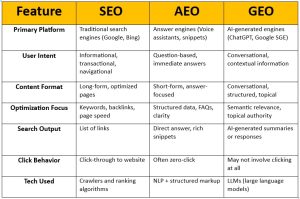
Key Differences Between SEO, AEO, and GEO
How SEO, AEO, and GEO Interact
These three forms of optimization aren’t mutually exclusive. In fact, they complement one another. SEO remains the foundation—if your site isn’t visible in SERPs, it won’t be referenced by AEO or GEO systems. Meanwhile, AEO and GEO build on SEO by addressing the changing behavior of users and search platforms.
Here’s how they can be integrated into a unified content strategy:
Start with SEO: Ensure your technical and content SEO is solid.
Add AEO: Structure your content to answer common questions using schema markup, headers, and concise formatting.
Build for GEO: Create comprehensive, authoritative content that conversational engines can reference easily.
Why Does This Matter in 2025?
Search is no longer a one-size-fits-all model. Google SGE is rolling out AI-generated responses. ChatGPT, Perplexity, and other AI tools are becoming go-to solutions for students, researchers, and consumers. In this environment, relying only on traditional SEO can leave your brand invisible to users who never see search engine results pages.
Key Takeaways:
SEO ensures your site is ranked.
AEO ensures your content is picked for direct answers.
GEO ensures your site is cited in AI-generated content.
To future-proof your digital presence, businesses and creators must adapt their strategies across all three domains.
Conclusion
SEO, AEO, and GEO are not competing strategies—they are phases of search evolution. Traditional SEO helps your site rank, AEO gets your content featured in quick answers, and GEO secures your place in AI-generated conversations. Understanding their differences and intersections can help you stay ahead in a rapidly transforming digital world.
Whether you’re optimizing a business site, running a content blog, or building a portfolio, embracing all three will ensure you remain visible, valuable, and relevant—no matter how users choose to search.
